The Federal Reserve Hikes
In the previous Wealth Report, we discussed how the Federal Reserve’s “hawks” were finding their wings. The hawks being the voting members of the Federal Reserve (“Fed”) who leaned toward hiking interest rates as inflation has remained persistently above target this year. New Fed Chair Kevin Warsh also signaled a harder line in recent months. This progression culminated in a unanimous vote to raise the Federal Funds rate by 0.25% in September, up to a range of 3.75%–4.00%. Chair Warsh left little ambiguity about the reasoning: “The plain fact is that inflation is too high and has been too high for too long.” This was the Fed’s first hike since July 2023 and officially marks the end of the easing cycle that began in September 2024, after a two and a half years post-COVID hike cycle.
Two forces did most of the work in shifting the Committee’s remaining holdouts into the hawks’ camp. First, the labor market refused to crack, and in fact appeared to strengthen exiting the summer. August payrolls grew by 162,000, nearly triple consensus expectations, while unemployment held at a historically low 4.1% and wages rose a solid 3.1% year-over-year. Second, energy prices reasserted themselves as a driving force of upside inflation risk, with August headline CPI accelerating to 3.4% year-over-year underpinned by a 3.9% monthly jump in gasoline prices. Long-term Treasury yields were a casualty of the inflation momentum, as the 10-year Treasury Yield hit 5% for the first time since 2007, and was a signal to the FOMC (the voting committee within the Federal Reserve) that no action could threaten their inflation fighting credibility.
2026 Year-to-Date Performance
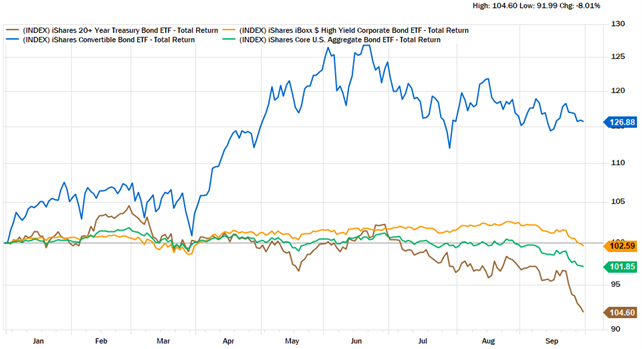
During the third quarter, fixed income total returns turned negative as declines in bond prices offset strong starting yields. Leading the market are convertible bonds (linked to equity markets which remain near all-time highs), while longer-duration bonds are lagging as the 10-year Treasury yield reaches 19-year highs.
Other Items of Interest
September FOMC Dot Plot
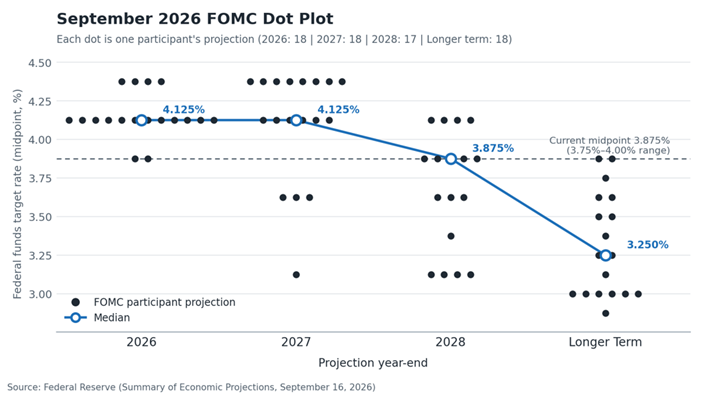
The September Dot Plot indicates the hawkish shift is not one-and-done. In addition to the September hike being unanimous, sixteen of eighteen FOMC participants now see at least one additional rate increase before year-end, implying a range of 4.00%–4.25% ending 2026, while eight members pencil in a further hike in 2027. Futures markets have followed the Committee’s Dot Plot direction, pricing meaningful odds for additional moves at both the October and December meetings as of the end of the quarter.
Meet the 2027 FOMC Voters
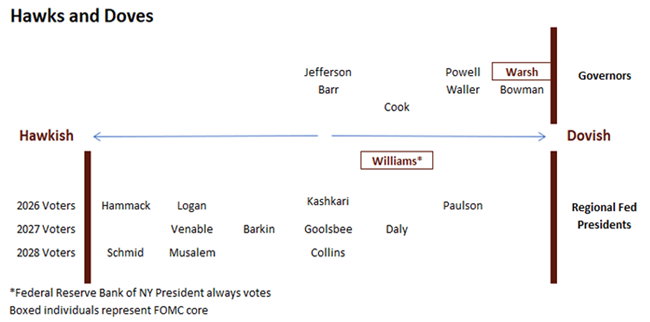
The FOMC voting committee is not a static entity. There are eight core permanent voting members, comprised of the seven “Board of Governors” plus the New York regional President. Additionally, there is a revolving group of four regional Fed presidents. Every January, four of the regional presidents rotate off the voting committee while four new ones rotate in. The incoming 2027 group looks different from 2026. Dallas’s Lorie Logan and Cleveland’s Beth Hammack, both consistently hawkish votes this year, rotate off, replaced by Chicago’s Austan Goolsbee (historically more dovish) and Richmond’s Thomas Barkin (considered a centrist). The wildcard is Atlanta, whose presidency remains vacant. Chair Warsh now has a say in the selection, and leading candidate Michael Faulkender recently said he believes “the votes are going to force Chairman Warsh to raise rates”, which is hardly a dovish opening bid. On net, the 2027 roster looks less hawkish than 2026, but only modestly so, and the final shape of the voting group is dependent on who fills Atlanta’s open seat.
The AI Debt Boom Tests Credit Markets
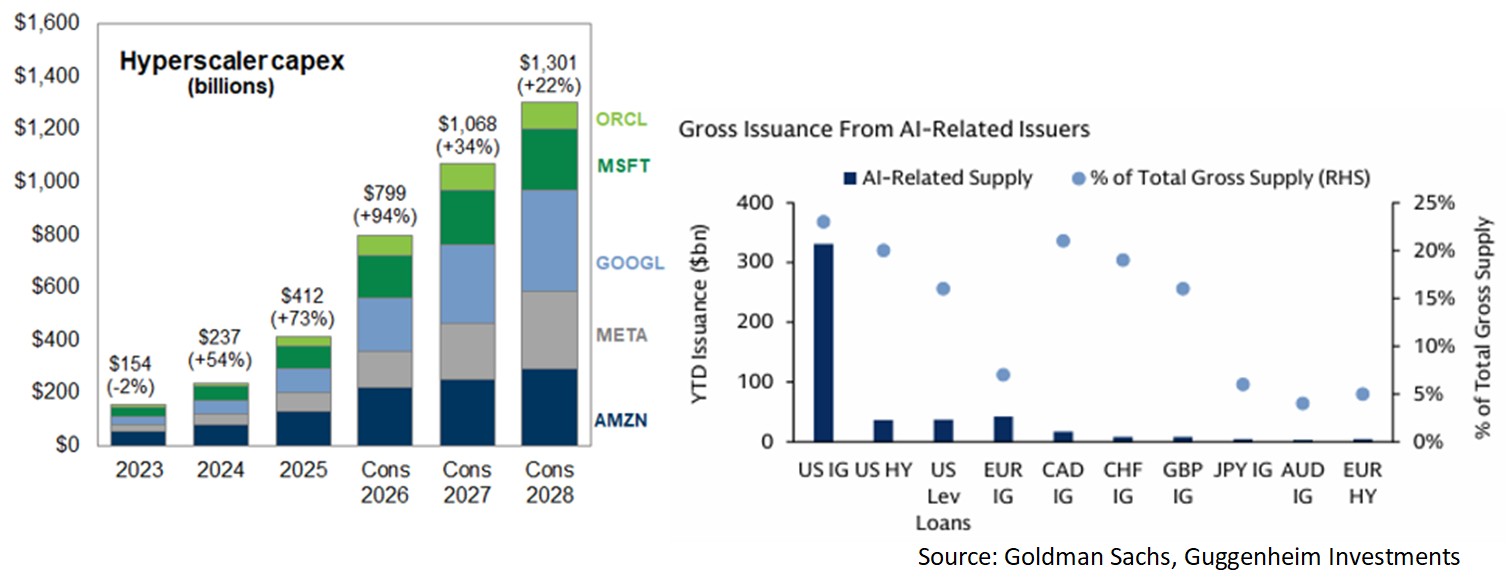
The fixed income market isn’t just about Treasuries right now. The buildout of AI infrastructure has become a defining and persistent force in credit markets. Corporate debt issuance tied to data centers and related capital spending from the five major hyperscaler companies alone is on pace to hit $800 billion this year, with total spending across the ecosystem closer to $3 trillion. Spreads on AI-related debt widened notably over the summer as investors grew more skeptical of the return on this capital spending, even as headline credit spreads remain historically tight. Hyperscaler bonds now make up roughly a fifth of the long-duration investment-grade index, a concentration worth watching as this generational wave of capital spending continues unabated.